

Home / Cultural Assessment Predictive Test Tool (CAPS)


LTC’s Cultural Assessment Predictive Success tool helps organizations evaluate cultural intelligence, communication tendencies, and emotional resilience so employees and teams can work more effectively in multicultural environments.
Today’s global workplace requires more than technical skill. The CAPS Tool gives organizations a practical, research based way to understand how individuals communicate, collaborate, make decisions, and adapt in cross cultural settings. The assessment highlights tendencies across key cultural dimensions and supports stronger self awareness, flexibility, and team effectiveness.
The CAPS Tool is designed for organizations that need employees to communicate clearly, build trust, and adapt across different cultural norms and working styles. It is especially useful in environments where global collaboration, relocation, and cross functional teamwork are essential.
Strengthen self awareness
Participants gain insight into how they naturally communicate, respond to feedback, collaborate with others, and navigate cultural differences.
Improve team collaboration
CAPS helps teams understand different working styles and cultural preferences so they can communicate more effectively and reduce friction.
Support global success
The assessment helps identify where more training, coaching, or support may be needed for leaders, expats, and globally mobile professionals.
Complete the assessment
Participants receive a secure link and complete a self reported questionnaire online. The format captures tendencies rather than fixed traits.
Review the cultural profile
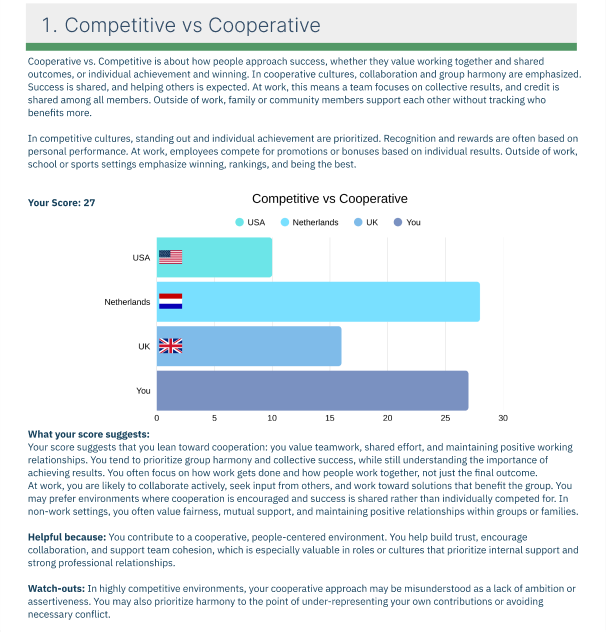
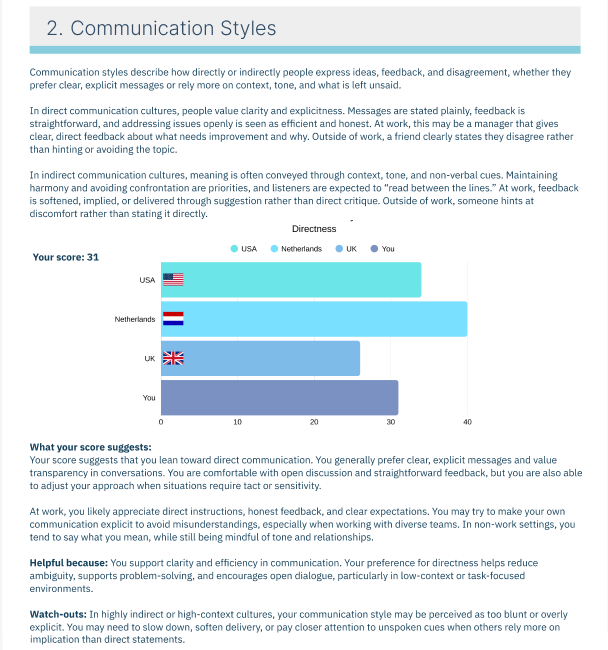
Results are presented along a spectrum, showing how a participant may lean across cultural dimensions such as direct versus indirect communication or competitive versus cooperative collaboration.
Apply the insights
Organizations and individuals can use the report to improve communication, adjust leadership style, strengthen multicultural teamwork, and identify training needs.
The CAPS report gives participants a practical starting point for understanding how they show up in multicultural environments. Depending on the assessment, the report may include insights such as:
Ideal for these business needs


Every culture is different, which is why no two training programs are alike. One training might teach general cultural competency strategies, while another is a focused analysis of a single target culture. Topics can include anything from the economy and religion to regional differences, language use, and social etiquette.
Our tailored approach ensures your team spends their time gaining the knowledge they need – and will use – most.
Are you seeking personal training in a one-on-one environment? Or do you require training in a group setting? LTC offers many different structure options for individuals or groups, in any length necessary to cover the needed information. We offer 2, 4, 8, or 16 hour blocks and can extend the training over multiple days. Our program managers can work with you to determine what structure would best meet your expectations.
If you, a colleague, your business, or organization have cultural competency learning needs, we’re here to help. Don’t hesitate to reach out to us if you have any questions. If you are interested in more information and pricing, click here to get started.
Ready to get started with your cultural competence classes? Click the link to fill out our short needs analysis survey.

Martin George is more than the Founder of LTC. He’s a teacher with a Doctorate in Linguistics, who’s lived abroad, speaks at conferences, and is able to hold his own in a conversation on just about any subject. Ready to listen to The 2nd Most interesting Man in the World? Enter Martin’s Mind.
Our corporate headquarters is located in Indianapolis, Indiana. We also have a satellite office in Orlando, Florida.
We run cultural competence programs in the U.S. as well as in Canada, Mexico, Europe, South America, Asia, Oceania, and Africa. We have been successfully working worldwide with the federal government since 2000 providing training in over 60 locations nationally and internationally to government linguists.
We can conduct cultural competence programs at work or at home, whichever is your preference. If a face-to-face class is not possible to arrange due to your schedule or location, we offer classes remotely via free platforms like Teams, FaceTime, Zoom, etc.
Your target is the culture or country that you want to learn about. The source culture or country is your home or place of residence.
LTC specializes in a variety of cultural training programs. In most cases we are able to create a customized program for any culture.
Start by completing the online needs analysis, and we will contact you to chat about your goals for your program of interest. After an initial discussion, if a cultural competence program with LTC sounds like a good fit, we’ll schedule an appointment to speak more in depth about your program either in person or over the phone and plan your class and curriculum options!
Email us anytime and one of our cultural specialists will reach out to you and discuss what your company’s needs are for cultural competence training. After we determine what you want and need, one of our curriculum coordinators will develop a program that is best suited to your business or organization and determine an appropriate program schedule.
Our curriculum coordinators carefully design your curriculum and instructional materials by combining information from your needs analysis, assessment(s), purpose of study, time constraints, learning styles, and goals.
Our coordinators will then work with your instructor to plan a syllabus for your program and design the activities, tasks, and exercises that will make up your class. These include real-life business and daily-life scenarios and situations, readings, podcasts, and other content which drive you to meaningful conversations about cultural similarities and differences.
Your curriculum plan is customized for you for your optimal learning experience!
Our trainings collect key information on your culture of study and transfer it to you via conversations and interactive activities. In this setting, participants assimilate lots of information in a short amount of time and without the task of memorizing it. The interactive nature of our course enables YOU to recall your training just when you need to!
Our instructors love everything about culture and are passionate educators. What’s more, they are experienced in our methodology. Their backgrounds are vast, ranging from linguistics to specific languages to education, among other areas of expertise. All instructors minimally hold Bachelor’s degrees, though many hold advanced degrees.
Each instructor is carefully selected to work with you. Your instructor is selected by a program manager to guide you to achieve your language goals. Your instructors will also report progress, success, and emerging needs to program managers, who will then organize that information and relay it to you as well as any other representative who needs it.
Almost definitely, yes. All LTC instructors have native experience within or have lived extensively in your target country or culture.
Probably, yes. Our first choice is always to keep you with the same instructor from start to finish. But in some circumstances – for example, if you go on an extended vacation, miss 15 consecutive business days, or some other unforeseen problem occurs – you may be placed with a new teacher.
In some circumstances, we can arrange to transfer LTC coursework into credits for your school, but most of the time school credit is not available.
Unfortunately, at this time we cannot support student visas.
No, there are no prerequisites to take an LTC cultural competence training course. We welcome everyone, no matter your level of cultural expertise!
After you complete your cultural competence training, we recommend you take an additional program at least once per year for the duration of the time you are living in your target culture. This allows you to reflect on what worked and what needs improved as you continue to work and live in a new culture.